
Eastland Projected Versus Actual Release
A projected release date is a calculation, not a completed custody event. TDCJ defines it as the date release is expected if parole does not occur first. The calculation can reflect the offense, sentence, credits, eligibility rules, and record corrections. A scheduled release date is more advanced. After a favorable Board vote, Classification and Records audits the release certificate and calculates a date and location, but TDCJ warns that even a scheduled date can change without notice.
An actual release date belongs to the completed release or discharge record. For state custody, release papers under Texas Government Code section 501.016 provide far stronger proof than a projection. For Eastland County Jail, ask for the completed release or transfer transaction. A transfer to TDCJ, ICE, the U.S. Marshals, another county, or a hospital is not community release.
A pretrial detainee usually lacks a sentence-based endpoint. Bond may be posted, the judge may change custody, the case may resolve, or another hold may prevent departure. The court record explains authority, while the jail record supplies the physical event and time.
Find an Eastland Projected Release Date
The route depends on who has custody. The TDCJ inmate search includes only people currently incarcerated in a TDCJ facility. Search data updates on working days and is at least 24 hours old. A current detail may show projected release, parole eligibility, and review information. Once a person leaves TDCJ, the public search removes that profile, so a blank result is not historical release proof.
The official search screen shows both its identity fields and its current-custody limit.
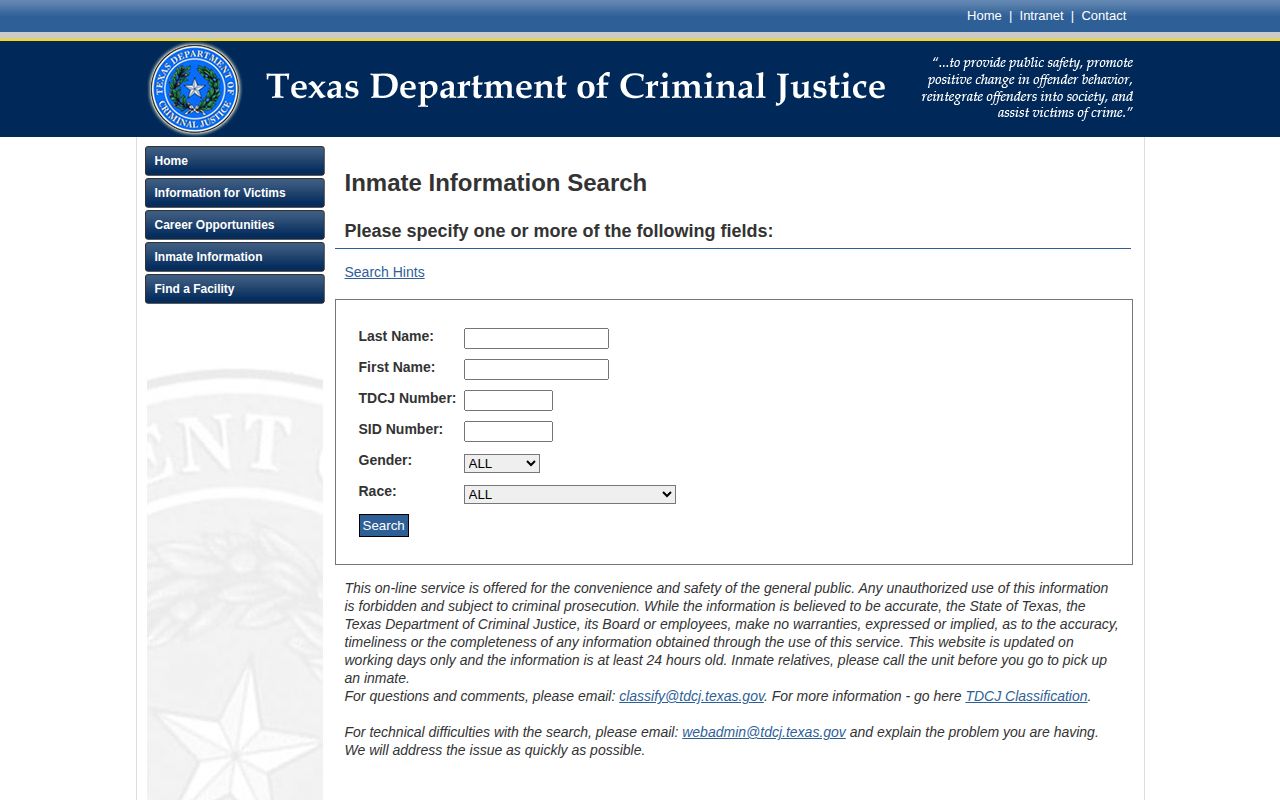
Those limits make the screen useful for present custody but unsuitable as an archive of Eastland County releases.
- Confirm the custodian. Check whether the Eastland booking ended in county release, county sentence, or transfer to TDCJ or another authority.
- For a current TDCJ prisoner, search exact last name with first name or initial, a seven-digit TDCJ number, or SID. Compare identity and conviction county.
- Read the field label exactly. Keep projected release, parole eligibility, Board review, and scheduled release separate.
- For a county sentence, contact the Eastland County Sheriff's Office and sentencing court. Ask for the actual local computation and jail credit.
- For a past state release, request TDCJ release papers or historical records. Do not rely on the current-only search.
The TDCJ email information route can return a projected date plus offense, location, and incarceration history. Supply full name and TDCJ number. If the number is unknown, use an exact birth date or approximate age with county of conviction. The main inmate-information lines are 936-295-6371 and 800-535-0283 on weekdays from 8 a.m. to 5 p.m.
For the complete county and state lookup chain, use the Eastland County release search and match the date to the underlying court or agency record.
Texas Prison Projected Release Credits
Texas Government Code Chapter 498 governs TDCJ good-conduct time. These credits are classification tools subject to statutory limits and forfeiture. They do not reduce every sentence in the same way, and they do not create an unconditional right to leave on the displayed date. Offense date, offense type, mandatory-supervision eligibility, Board action, and disciplinary history can all matter.
Government Code Chapter 508 governs parole and mandatory supervision. Eligibility allows review under the applicable rule. It is not release. Texas Board panels review files rather than conduct ordinary formal public parole hearings. A favorable vote may carry conditions, treatment, residence approval, or a future eligibility date. Release still awaits the certificate audit and processing.
TDCJ publishes the controlling terminology on its Definitions and Acronyms page.
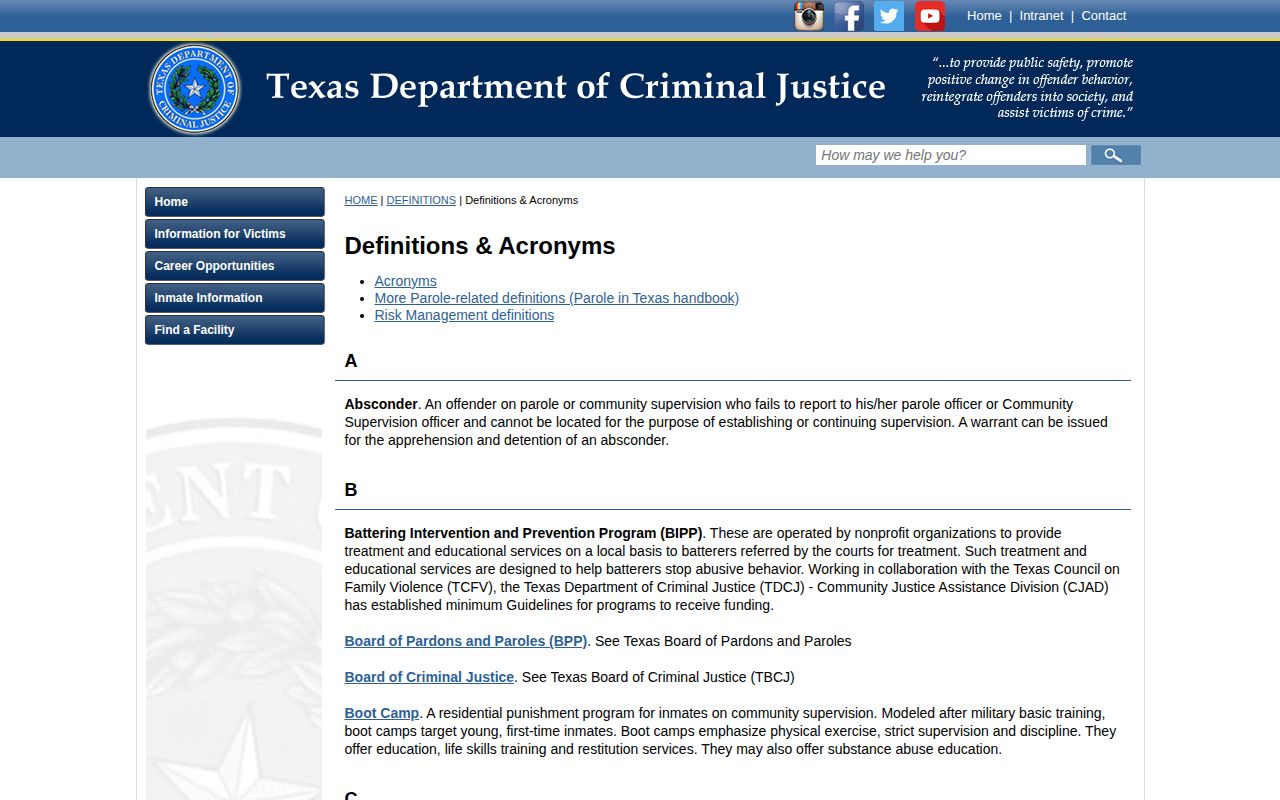
The definitions reinforce why projected, eligible, scheduled, released, and discharged should never be used as synonyms.
The TDCJ Independent Ombudsman reports that a scheduled date is commonly calculated 14 to 21 business days after Classification and Records receives the release certificate. That is a processing estimate, not a guarantee. Detainers, required programs, record corrections, and new action can alter the path.
Note: Never apply one percentage to an Eastland sentence unless the controlling statute and official computation support it.
Why Eastland Release Dates Change
A date can move because a projection depends on facts that are still being processed. The reason should come from the responsible record, not from arithmetic performed outside the agency. Ask which event caused the change and when it entered the computation.
| Factor | Possible effect | Record to check |
|---|---|---|
| Good-time award or loss | Changes the credit calculation where applicable | TDCJ time sheet or county computation |
| Board vote | May approve, deny, or set later review and conditions | BPP vote and release certificate |
| Detainer or hold | Can produce transfer instead of community release | Custodian release line and receiving agency |
| Court order or correction | May change sentence, credit, or authority | Signed order and corrected agency record |
| Program or residence condition | May delay release processing | Board condition and Parole Division record |
| Weekend or holiday | May alter a local county discharge day | Eastland jail computation under Article 42.035 |
A Board code must be translated precisely. FI codes generally signal approval with different timing or program terms. NR, SA, and DMS communicate distinct denial or review outcomes. The official BPP voting-options definitions should control the reading.
Confirm Eastland Actual Release Dates
For Eastland County Jail, call 254-629-1774 with the full name, approximate booking date, and cause or booking number when known. Ask whether the booking ended in release to the community or transfer. Then request the date, time, type, destination, and completed transaction through the Sheriff's official public-information form.
For state custody, TDCJ release papers and its historical records route provide the actual event. Submit a request through the TDCJ Open Records channels when the normal current-inmate tools are insufficient. A release paper can identify discharge, parole, mandatory supervision, or another legal basis and include the time-served data required by statute.
Texas IVSS can send registered users an event notice for TDCJ custody and supervision. County VINELink handles a separate local layer. Notification is prospective and may lag processing, so preserve the alert and ask the contributing office for the record behind it. The Eastland County VINELink check explains the two paths.
Eastland County Release Computation
Eastland county-jail timing is not the TDCJ projected-release formula. Texas Code of Criminal Procedure Chapter 42 supplies the local rules. Article 42.032 permits county good-conduct commutation under sheriff and local rules. That means a reader should request Eastland's actual computation rather than import a TDCJ date or assume a statewide daily-credit formula.
Article 42.035 permits discharge on the preceding business day when a county sentence would end on a Saturday, Sunday, or legal holiday, but only at the sheriff's discretion based on public safety. It is not an automatic promise of early release. The jail record should show what was actually done.
Ask for the sentence start, jail credit, good-conduct credit applied, forfeiture if any, controlling end date, weekend or holiday adjustment, and each hold or receiving agency. Pair that response with the signed Eastland judgment. This is the only sound way to reconcile a county estimate with physical departure.
Eastland Release Date Proof
The proof hierarchy prevents a search result from being treated as more certain than it is. A current TDCJ match strongly supports current state imprisonment as of the stated lag. A projection predicts a possible future event. A scheduled date reflects advanced processing. A completed release transaction or statutory release paper documents what occurred.
Use three sources when the date is disputed: the custodian event, the court or Board authority, and the supervision status after release. Conflicting dates require a question to the source agencies. Do not select whichever date appears first online.
Historical Eastland Release Date Records
A date inquiry often begins after the person has already disappeared from a live system. For an Eastland jail booking, request the booking sheet and release screen for that exact event. Include aliases, approximate booking and release dates, arresting agency, incident or cause number, and date of birth when appropriate. Ask for the recorded release time, legal type, destination, receiving agency for any transfer, and releasing authority. Narrow detail reduces both mistaken identity and avoidable collection cost.
For TDCJ history, the email information route may give incarceration and projected-date data, but it may not satisfy a request for the completed transaction. A formal Public Information Act request should seek the release or discharge date, legal basis, releasing unit, supervision status, assigned office, and transfer destination. Government Code section 501.016 papers also state the offense, sentence date and length, sentencing county, actual calendar time, good-conduct time, and total served.
The court judgment answers what the judge ordered. It may contain the sentence, jail credit, disposition, and later modification. Yet the judgment alone may not show the moment the person left a facility or whether another sovereign accepted custody. Pair it with the custodian event. For federal custody, use the BOP locator and federal record routes; for an ICE handoff, the ICE locator is only a current or recent lead, not a historical release ledger.